
The Complete Professional Color Analysis Kit
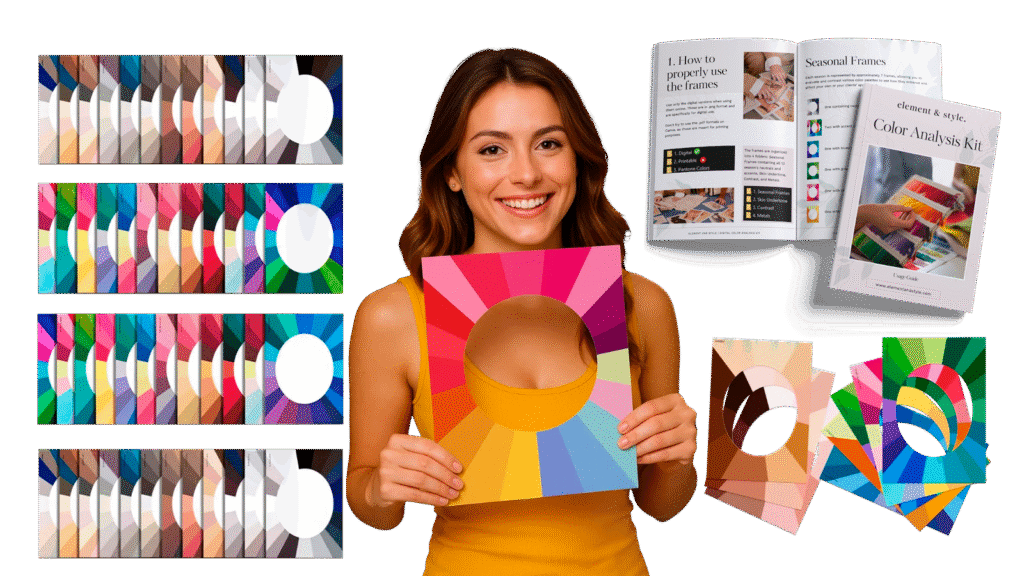
A complete set of professionally printed color frames —ready to use in your client sessions.
35 Printed Expert Frames • 12-Season System • Includes Metallic Tests & Neutrals
Special Offer:[woo_multi_currency_exchange price=99.99][woo_multi_currency_exchange price=69.99]
📦 Printed & shipped worldwide 


Printed professional frames
Durable, calibrated colors for real-life analysis.
Includes seasonal neutrals
Complete palettes most kits don’t include.
Metallic test cards included
Real gold & silver finish for jewelry testing.
Trusted by 500+ professionals
Used in consultations around the world.
Why Most Color Analysis Leaves Clients Confused
Picture this: You’ve just told a client she’s a Spring. She’s excited. She leaves with a colorful palette card.
Three weeks later, she’s standing in a store holding two blue shirts. One is bright turquoise. One is soft periwinkle. The palette says “wear blue.” But which blue?
She guesses. She’s wrong. It doesn’t work.
This happens because traditional color analysis is missing three critical pieces:
1. No diagnosis – You can’t prove WHY someone is a Spring. You just eyeball it and hope you’re right.
2. No neutrals – Clients get colorful palettes but don’t know which gray, beige, navy, or white to actually buy. (Neutrals are 80% of wardrobes.)
3. No practical tools – “You’re a Summer” is meaningless in a store with 47 shades of red lipstick.
The result? Clients lose confidence. They second-guess everything. They stop using your recommendations.
It’s not their fault. It’s incomplete tools.
What Professional Color Analysis Actually Needs
The Three Missing Pieces
Missing Piece #1: DIAGNOSIS
Most kits just hand you 12 seasonal palettes and say “figure it out.”
How do you KNOW someone is an Autumn versus a Spring? You’re guessing based on vibes.
When a client asks “But how do you know?” you can’t answer with data. You lose credibility.
Professional color analysis starts with measurable variables:
- Undertone (warm, neutral, cool)
- Depth (fair to deep skin)
- Contrast (low or high)
- Saturation (muted or clear colors)
These variables point you to 2-3 likely seasons.
Then you confirm.
That’s diagnosis. That’s professional.
Missing Piece #2: NEUTRALS
Here’s what nobody talks about:
Colorful palettes are exciting but practically useless.
Your client already knows she looks good in coral. That’s not the problem.
The problem is she owns 6 white shirts and only 1 works. She has 4 gray blazers and they all look wrong. Her “beige” trench coat makes her look tired.
Neutrals are 80% of wardrobes. They’re the foundation everything else sits on.
But most kits don’t include neutral frames. So clients leave with no idea which whites, grays, beiges, navies, or camels are theirs.
This is the biggest missed opportunity in color analysis.
Missing Piece #3: PRACTICAL TOOLS
Telling someone “You’re a Winter” means nothing at Sephora.
- She’s staring at 40 red lipsticks. Which one is her red?
- She needs a blue blazer. The rack has 12 blues. Which one?
- She wants green. Olive? Forest? Mint? Moss? Sage?
Clients need decision-making tools, not just palette theory.
They need:
- Warm vs cool red comparison
- Blues guide (because everyone needs blue)
- Greens & browns breakdown
- Which pastels (if any)
- Which colors to avoid completely
Without these tools, your analysis is academic theory, not practical shopping help.
Special Offer:[woo_multi_currency_exchange price=99.99][woo_multi_currency_exchange price=69.99]
📦 Printed & shipped worldwide
INTRODUCING THE 5-BLOCK METHOD
The industry traditionally offers two extremes:
Fabric drapes: $500-2,000. Beautiful but bulky, fade over time, require storage space, and clients can’t photograph them for shopping reference.
Basic frame kits: $30-50. Just 12 seasonal palettes. No diagnostic frames. When clients ask “how do you know I’m this season?” you can’t show them the data.
We built this kit after 2 years of testing with 50+ professional color analysts.
The brief was simple: “What’s the minimum number of frames needed to do complete, professional color analysis?”
Not 12 (too basic). Not 100 (information bloat).
The answer: 35 frames, organized into 5 strategic blocks.
Every frame earns its place. Nothing redundant. Nothing missing.
🎨 Everything You Need for Professional Color Analysis
What it includes:
- 3 undertone frames (warm, neutral, cool)
- 6 skin depth frames (fair, light, medium, tan, dark, deep)
- 1 contrast frame (low vs high comparison)
Why it matters: Before you can tell someone their season, you need to measure their variables. This is what separates professional color analysis from guessing.
When you drape these 10 frames, you’re gathering data:
- Their undertone eliminates half the seasons immediately
- Their depth narrows it to 3-4 possibilities
- Their contrast confirms the final choice
By the time you move to Block 2, you already know which 2-3 seasons to test. You’re not randomly trying all 12.
This is what credibility looks like.
Clients ask “How do you know I’m an Autumn?” You can show them frame-by-frame why.
What it includes: All 12 seasonal subtypes:
- Springs: Bright, Light, True
- Summers: Light, Soft, True
- Autumns: Soft, True, Dark
- Winters: Dark, Bright, True
Why it matters: Now that you have their diagnosis (Block 1), you confirm their exact season.
Instead of testing all 12 palettes randomly, you’re comparing 2-3 finalists side-by-side.
Example: Diagnosis says warm, medium depth, medium-high contrast → You test True Spring vs. True Autumn vs. Bright Spring.
Side-by-side comparison is faster and more accurate.
The client sees the difference immediately. One palette makes their eyes bright and skin clear. The others wash them out.
They trust the result because they saw the proof.
What it includes:
- 1 saturation comparison frame (muted vs clear colors)
- 3 metal frames with real metallic inks (soft gold, silver/platinum, rose gold)
Why it matters: Fine-tuning details that complete the picture.
Saturation confirms if someone is a soft/muted season (Soft Summer, Soft Autumn) or a bright/clear season (Bright Spring, Bright Winter). This helps when they’re between two seasons.
Metals are 30% of someone’s look. Getting jewelry wrong undermines the entire analysis.
These frames use authentic metallic inks (not CMYK simulation). The shimmer is real. You can see which metal actually reflects their coloring.
- Soft gold: Light Summer, Soft Summer, Soft Autumn
- Silver/platinum: All Winters, True Summer
- Rose gold: All Springs, Light/Soft Summers, Soft Autumn
Clients leave knowing exactly which jewelry to buy and which to donate.
What it includes: 4 frames, one for each season:
- Spring Neutrals (20-25 colors)
- Summer Neutrals (20-25 colors)
- Autumn Neutrals (20-25 colors)
- Winter Neutrals (20-25 colors)
Each frame shows:
- Which whites, off-whites, creams
- Which grays (warm vs cool, light vs dark)
- Which beiges, taupes, camels
- Which navy shades
- Which browns (if any)
- Which blacks (or black alternatives)
Why this is the game-changer:
Most color analysis kits don’t include neutrals. This is a massive oversight.
Here’s what happens without neutral guidance:
Your client is a Summer. You tell her to wear soft, cool colors. She nods.
She goes shopping. She picks up a “gray” blazer. Is it her gray? She doesn’t know. There are 8 grays on the rack. She guesses. She picks warm gray (wrong). It doesn’t work with anything.
Multiply this by every neutral purchase. Every white shirt. Every beige trench coat. Every navy pant. Every gray sweater.
Now imagine this instead:
She has a photo on her phone of her 20 Summer neutrals. She holds up the gray blazer next to her phone. She compares. It matches the cool gray on her frame. She buys with confidence.
This is why seasonal neutral frames matter more than colorful palettes.
Neutrals are the foundation. Everything else is decoration.
Clients photograph this frame and keep it forever. It’s their wardrobe blueprint.
What it includes:
- Warm vs Cool Reds (lipstick selection guide)
- Blues for All Seasons (universal color family)
- Greens & Browns (the warm spectrum)
- Soft Pastels (who can wear them)
- Season-Specific Challenging Colors (mustards, neons, deep purples)
Why it matters: After diagnosis and confirmation, clients need shopping tools.
Reds frame: Every woman needs red (lipstick, dress, blazer). But “red” has 40 variations. This frame shows warm reds vs cool reds side-by-side. Clients instantly see which direction is theirs.
Blues frame: Blue is universal. Everyone wears blue. But which blue? Navy? Periwinkle? Royal? Teal? This frame breaks down the blue family by season.
Greens & Browns frame: The earth tone spectrum. Which greens work (olive vs mint vs forest). Which browns exist for their season. Critical for casual wear.
Pastels frame: Soft pastels are tricky. They work beautifully for Light Spring and Light Summer but can wash out other seasons. This frame shows who can wear them and how.
Challenging Colors frame: Some colors only work for specific seasons. Mustard yellow (Autumn only). Neon lime (Bright Spring only). Deep purple (Winter only). This frame helps clients identify colors to avoid or embrace.
Result: Clients leave confident. They know what to buy, what to avoid, and why.
Why frames beat drapes:
Clearer results • No fading • Portable • Clients can photograph • 1/10th the price
Why 35 frames?
The minimum for complete diagnosis without redundancy. Every frame earns its place.
👉 Result: 30-40 minute sessions. Clients understand everything. Compact, organized, affordable.
🎨 Comparison table:
| Basic 12-Frame Kits | This System (35 Frames) | Fabric Drapes | |
|---|---|---|---|
| Price | $30-50 | $69 | $500-2,000 |
| Diagnostic frames | ❌ None | ✅ 10 frames | ✅ Yes (with training) |
| Seasonal palettes | ✅ 12 | ✅ 12 | ✅ Yes |
| Seasonal neutrals | ❌ None | ✅ 4 frames ⭐ | ❌ Rarely included |
| Practical tools | ❌ None | ✅ 5 frames | ⚠️ Some |
| Client can photograph | ⚠️ Palette only | ✅ Everything | ❌ No |
| Portable | ✅ Yes | ✅ Yes | ❌ Bulky |
| Won't fade | ⚠️ Eventually | ✅ Never | ❌ Fades with use |
| Storage | Easy | Easy | Requires space |
| Typical session | 20 min (incomplete) | 30-40 min (complete) | 45-60 min |
| Best for | Hobbyists | Professionals & serious enthusiasts | High-end consultants |
Current Production Batch
This batch ships in 3-5 business days
Next production run: December 15, 2025
(6 week wait if this batch sells out)
We produce in limited batches to maintain quality control and ensure every kit meets our standards.
Special Offer:[woo_multi_currency_exchange price=99.99][woo_multi_currency_exchange price=69.99]
📦 Printed & shipped worldwide
From Confusion to Clarity in 35 Minutes
Here's how a typical color analysis session flows with this kit:
- Draping undertone frames (warm, neutral, cool)
- Draping depth frames (fair to deep)
- Quick contrast check
- Quick saturation check
- Eliminates wrong temperature (50% of seasons gone)
- Identifies depth level
- Notes contrast and saturation
- Based on diagnosis, test 2-3 finalist seasons side-by-side
- Let client see the difference themselves
- Confirm final season
Test: True Spring vs True Autumn vs Soft Autumn
Client tries all three. True Autumn makes her glow. The other two are close but not quite right.
- Test metals (gold, silver, rose gold)
- Show seasonal neutrals frame → client photographs this
- Review practical tool frames (reds, blues, greens)
- Answer specific questions
- Jewelry recommendations
- Photo of their 20 neutrals (wardrobe foundation)
- Understanding of their reds, blues, greens
- Confidence to shop alone
- Recap their season and why
- Show them how to use their photos while shopping
- Answer final questions
- Book follow-up if needed (wardrobe audit, shopping tour)
- Photo of seasonal palette
- Photo of seasonal neutrals
- Clear understanding of why these colors work
- Confidence to rebuild their wardrobe strategically
The Difference Between This and Incomplete Kits
Why Professional Analysts Are Switching to Frames
Fabric drapes have been the gold standard for decades. They're beautiful, tactile, traditional.
They're also $500-2,000, bulky, fade over time, and honestly? Most clients respond better to solid color frames anyway.
Here's why:
- Beautiful, luxurious presentation
- Traditional professional tool
- Tactile experience
- Bulky (requires large bag or case)
- Heavy (difficult for mobile consultations)
- Fades with use (especially near windows)
- Requires laundering between clients
- Texture can distract from color effect
- Clients can't photograph drapes for shopping
- Storage space needed
- Expensive to replace
- Compact (A4 size, fits in small bag)
- Lightweight (portable for mobile consultations)
- Never fades (printed with archival inks)
- Wipe clean between clients (hygienic)
- Solid colors show effect clearly (no texture distraction)
- Clients photograph frames for shopping⭐
- Minimal storage space
- Affordable to own multiple sets
- Less "luxurious" presentation than fabric (though quality is professional)
- Some traditional consultants prefer fabric
Many analysts don't realize this, but fabric texture can actually make it harder for clients to see the color effect on their skin.
- The color
- The fabric texture (silk vs cotton vs wool)
- How the drape falls
- How it feels
Solid color frames eliminate everything except the color itself.
The client's brain can focus 100% on "Does this color make my skin look clear and bright, or tired and dull?"
Bottom Line
Both work. Both are accurate. Frames are more practical for most analysts.
Special Offer:[woo_multi_currency_exchange price=99.99][woo_multi_currency_exchange price=69.99]
📦 Printed & shipped worldwide
Genuine stories from those already using it👩🎓
Real results from real people who are now applying color analysis with greater confidence than ever before.







Comprehensive Content Guarantee:
We are 100% confident this kit will equip you with all the precise visual tools and essential guidance needed to transform your color analysis practice.
Frequently Asked Questions👩🎓
Explore More Color Analysis Products
-
Sale!
Complete Bundle: All 3 Applied Color Guides
$44.97Original price was: $44.97.$34.97Current price is: $34.97. Add to cart -
Sale!
Makeup Color Analysis
$29.97Original price was: $29.97.$14.99Current price is: $14.99. Add to cart -
Sale!
Color with Purpose: Hair Color Theory
$29.97Original price was: $29.97.$14.99Current price is: $14.99. Add to cart -
Sale!
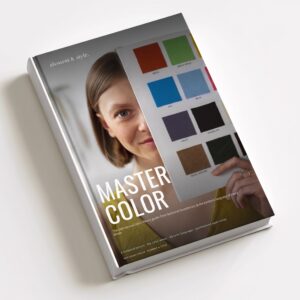
Master Color: Professional Color Theory
$29.97Original price was: $29.97.$14.99Current price is: $14.99. Add to cart -
Sale!
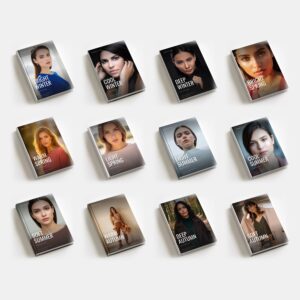
Complete Bundle: All 12 Seasons + Palette Sheets
$194.87Original price was: $194.87.$89.97Current price is: $89.97. Add to cart -
Sale!
Soft Autumn: Seasonal Color Guide
$29.97Original price was: $29.97.$14.99Current price is: $14.99. Add to cart -
Sale!
Deep Autumn: Seasonal Color Guide
$29.97Original price was: $29.97.$14.99Current price is: $14.99. Add to cart -
Sale!
Warm Autumn: Seasonal Color Guide
$29.97Original price was: $29.97.$14.99Current price is: $14.99. Add to cart -
Sale!
Soft Summer: Seasonal Color Guide
$29.97Original price was: $29.97.$14.99Current price is: $14.99. Add to cart -
Sale!
Cool Summer: Seasonal Color Guide
$29.97Original price was: $29.97.$14.99Current price is: $14.99. Add to cart -
Sale!
Light Summer: Seasonal Color Guide
$29.97Original price was: $29.97.$14.99Current price is: $14.99. Add to cart -
Sale!
Light Spring: Seasonal Color Guide
$29.97Original price was: $29.97.$14.99Current price is: $14.99. Add to cart