
Picture this: you’re standing in a dressing room under harsh fluorescent light, holding a sweater you swore looked amazing on the hanger. Now it makes you look tired, washed out, maybe a little green. Meanwhile, your friend tries it on and suddenly the sweater belongs to her. Same fabric, same cut, same color — completely different result.
That moment is exactly why 4 season color analysis exists. It’s the original framework that explains why some colors light you up while others drag you down, and it remains the foundation every modern color system builds on. Whether you’re curious about your own palette or you’re training as an image consultant, understanding the four-season method is where it all starts.
What 4 Season Color Analysis Actually Is
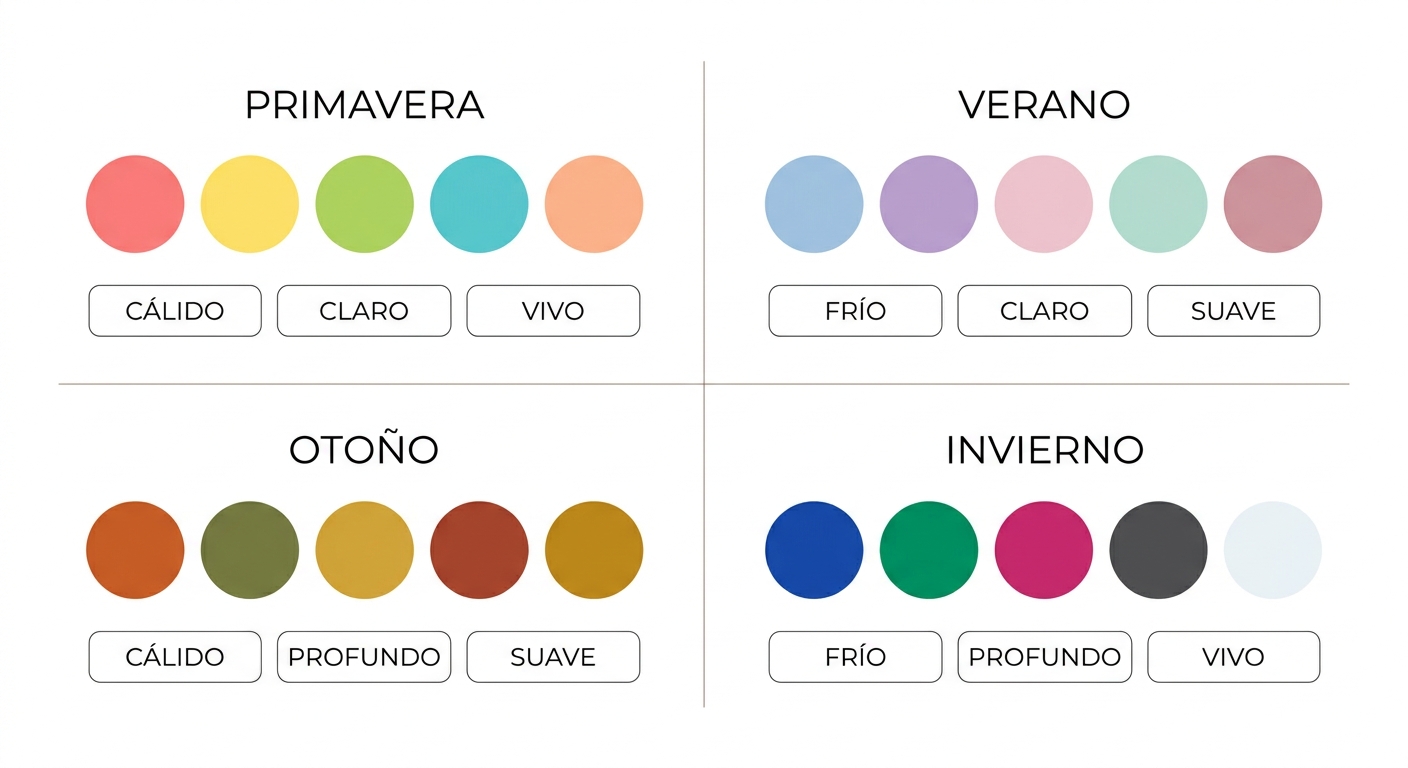
The four-season system sorts people into one of four color families — Spring, Summer, Autumn, or Winter — based on how their natural coloring relates to the colors found in each season of the year. Spring corresponds to warm, light, clear colors. Summer to cool, soft, muted tones. Autumn to warm, deep, earthy shades. Winter to cool, deep, vivid colors.
The system was popularized in the United States in the 1980s by Carole Jackson’s bestseller Color Me Beautiful, though its roots go back further to color theorists like Johannes Itten at the Bauhaus, who noticed that his art students naturally gravitated toward palettes that complemented their own coloring. You can read more about the broader history on Wikipedia’s personal color analysis entry.
The genius of the four-season approach is its simplicity. Instead of memorizing hundreds of shades, you learn one palette of roughly 30 to 40 colors that consistently flatter you. That’s enough to build a wardrobe, choose makeup, and stop second-guessing every clothing purchase.
The three qualities behind every season
Each season is defined by a combination of three characteristics:
- Undertone: warm (yellow/golden base) or cool (blue/pink base)
- Value: light or deep
- Chroma: clear/bright or soft/muted
Spring is warm + light + clear. Summer is cool + light + soft. Autumn is warm + deep + soft. Winter is cool + deep + clear. Once those three sliders click into place, you have your season.
How Do You Know Which Season You Are?

This is the question every reader wants answered, and honestly, the most accurate way is a draping session with a trained consultant. But you can get surprisingly close on your own with good lighting, a mirror, and a little patience.
Step 1: Find your undertone
Wash your face, remove all makeup, and stand near a window in natural daylight. Skip the artificial bulbs — they lie. Now look at the inside of your wrist. Do your veins read more blue or purple? You’re likely cool. More green or olive? Likely warm. A mix of both? You may be neutral, which usually still leans slightly one direction once tested with fabric.
Another test: hold a piece of pure white paper next to your face. If your skin looks yellowish or peachy against it, you’re warm. If it looks pink, rosy, or bluish, you’re cool.
Step 2: Test with gold and silver
Place a gold piece of jewelry against one side of your face and silver against the other. The metal that makes your skin look smoother, brighter, more even — that’s your undertone. Gold = warm (Spring or Autumn). Silver = cool (Summer or Winter).
Step 3: Find your value
Look at the overall contrast between your hair, skin, and eyes. High contrast (dark hair, light skin, bright eyes) leans Winter. Medium contrast leans Spring or Autumn. Low contrast (everything in a similar light or medium register) often points to Summer.
Step 4: Find your chroma
Are your features crisp and clear, or do they blend softly into one another? Clear coloring suits Spring and Winter. Soft, blended coloring suits Summer and Autumn.
The Four Seasons in Detail

Let’s walk through each one with concrete examples so you can see where you might land.
Spring: warm, light, clear
Springs have a golden warmth that looks lit from within. Think peachy or ivory skin, golden blonde, strawberry blonde, or warm light brown hair, and clear blue, green, or warm hazel eyes. Celebrities often cited as Springs include Nicole Kidman in her natural strawberry-blonde phase and Amy Adams.
Best colors: coral, peach, warm turquoise, camel, ivory, golden yellow, periwinkle, salmon pink, light warm green.
Avoid: black (too heavy), pure white (too stark), burgundy, navy on its own, dusty muted shades that drain the natural brightness.
Summer: cool, light, soft
Summers carry a rosy or ash-toned coolness with a soft, blended quality — like a watercolor painting. Skin tends toward pink or neutral-cool, hair is often ash blonde, mousy brown, or cool brown with gray that comes in beautifully silver. Eyes are typically soft blue, gray-blue, or gray-green. Think Jennifer Aniston, Cate Blanchett, Michelle Pfeiffer.
Best colors: powder blue, soft rose, lavender, mauve, dusty pink, sage, raspberry, cool taupe, soft burgundy.
Avoid: orange, tomato red, mustard, bright yellow, anything that screams “warm.” These shades overpower a Summer’s gentle coloring.
Autumn: warm, deep, soft
Autumns are the season of rich earth tones. Skin has golden, bronze, or olive warmth. Hair leans copper, auburn, warm brunette, or deep golden brown, and eyes are often warm brown, hazel, amber, or warm green. Julia Roberts, Jessica Chastain, and Eva Mendes often get placed here.
Best colors: rust, terracotta, mustard, olive, camel, chocolate, teal, pumpkin, warm ivory, deep moss green.
Avoid: icy pastels, bubblegum pink, pure black, fuchsia. Cool, bright shades make Autumns look sallow.
Winter: cool, deep, clear
Winters have the highest natural contrast and the coolest undertone. Skin can be very fair with pink undertones, neutral, olive, or deep brown with cool undertones. Hair is dark brown to black (sometimes platinum), and eyes are vivid — icy blue, deep brown, true green. Think Lupita Nyong’o, Anne Hathaway, Liv Tyler, Krysten Ritter.
Best colors: true red, pure white, black, royal blue, emerald, fuchsia, icy pink, lemon yellow, deep purple.
Avoid: muted earth tones, beige, orange, gold-based yellows. They dull the natural drama.
A Quick-Reference Table for the Four Seasons
| Season | Undertone | Value | Chroma | Signature Colors |
|---|---|---|---|---|
| Spring | Warm | Light | Clear | Coral, peach, warm turquoise, golden yellow |
| Summer | Cool | Light | Soft | Powder blue, mauve, soft rose, sage |
| Autumn | Warm | Deep | Soft | Rust, olive, mustard, camel, teal |
| Winter | Cool | Deep | Clear | True red, royal blue, emerald, pure white |
Why 4 Season Color Analysis Still Matters in 2026
You may have noticed that color analysis is having a major moment again. TikTok is full of “get your colors done” videos, and 12-season and 16-season systems are everywhere on Instagram. So why circle back to the classic four-season method?
Because every more advanced system is just a refinement of these four. The 12-season system, for example, splits each main season into three subtypes (Spring becomes Bright Spring, Warm Spring, Light Spring). The 16-season tonal method adds even more nuance. But if you don’t understand the parent seasons, the subtypes are nonsense.
For most people — and especially for someone analyzing themselves for the first time — the four-season framework is enough to make dramatic improvements to a wardrobe. You don’t need to know whether you’re a Bright Winter or a Deep Winter to know that emerald looks incredible on you and mustard does not.
For working stylists and consultants
If you’re an image consultant or personal stylist building a service offering, the four-season method is also the easiest entry point for new clients. People grasp “Spring, Summer, Autumn, Winter” intuitively. You can always upsell a more detailed 12-season analysis later, but starting with the foundational system keeps the conversation accessible and gets people in the door.
Professional draping is the gold standard for accurate placement. A good 4 season color analysis session uses fabric drapes in carefully calibrated shades, held under the chin in neutral daylight, while the consultant watches for how the face responds. Does the skin look smoother? Do the eyes brighten? Do shadows under the eyes recede? Those reactions tell the truth that no online quiz can match.
Common Mistakes When Self-Analyzing
Plenty of people try to figure out their season at home and land in the wrong one. Here are the most frequent pitfalls:
- Testing in artificial light. Fluorescents add green, incandescents add yellow, LEDs vary wildly. Always use north-facing daylight if possible.
- Wearing makeup during the test. Foundation, bronzer, and blush will skew everything. Bare skin only.
- Confusing dyed hair for natural coloring. Your season is determined by your skin and eyes, not your current highlights.
- Assuming dark skin equals Winter or Autumn. Deep skin tones exist across all four seasons. A Deep Autumn and a Deep Winter both have rich coloring but completely different undertones.
- Trusting a single test. Use the wrist test, the gold/silver test, and the white paper test together. Patterns matter more than any single result.
The “I look good in everything” trap
Some people swear they look great in every color. Usually what’s actually happening is that they look fine in most colors but extraordinary in their true season. Once you see yourself in your real palette, the difference is undeniable — strangers compliment you, photos come out better, you stop needing to layer concealer.
Building a Wardrobe Around Your Season
Once you know your season, the practical question becomes: now what? You don’t have to throw out everything in your closet. Start here:
- Prioritize the colors closest to your face. Tops, scarves, jewelry, and makeup matter most. Pants and shoes have more flexibility.
- Build neutrals first. Each season has its own best neutrals — ivory and camel for Spring, soft gray and rose-beige for Summer, chocolate and olive for Autumn, black and pure white for Winter.
- Add 3-4 accent colors from your palette that you genuinely love and that work for your lifestyle.
- Keep “off-season” pieces away from your face. Love a black dress but you’re a Spring? Wear it with a coral scarf or warm makeup to bring the harmony back.
If you want a starting point without committing to a full closet overhaul, try a análisis de colorimetría y estilo gratuito to see what fits your natural coloring before you buy anything new.
What About Makeup?
Makeup is where color analysis pays off fastest, because a $20 lipstick swap can change your whole face. Quick guidelines:
Foundation and concealer
Match undertone first, shade second. A Spring or Autumn needs warm/yellow-based foundation. A Summer or Winter needs cool/pink-based. Wearing the wrong undertone is the number one reason foundation looks “off” on otherwise great skin.
Lipstick
- Spring: coral, peach, warm pink, soft red with orange undertone
- Summer: rose, mauve, berry, soft cool pink
- Autumn: brick, terracotta, brown-red, warm nude
- Winter: true red, fuchsia, plum, cool berry
Eye makeup
Springs glow in warm browns, peaches, and soft greens. Summers shine in taupes, soft plums, and cool grays. Autumns own bronze, copper, and forest. Winters can pull off true black liner, deep navy, and icy highlights that would overwhelm anyone else.
Tools of the Trade for Consultants
If you’re reading this as a working stylist, the difference between a good analysis and a great one often comes down to your equipment. Quality drapes in true, calibrated colors are essential — printed cotton or random thrifted scarves won’t cut it for client work.
A purpose-built Four-Season Color Analysis Drape Set at $119 covers the core palettes for Spring, Summer, Autumn, and Winter with fabrics chosen specifically for accurate skin response. It’s the kind of tool that pays for itself within a handful of paid sessions, and clients can immediately see the difference when you drape them properly versus eyeballing it.
You’ll also want neutral gray draping cloth to neutralize clothing colors, a white wall or backdrop, and access to north-facing daylight or a daylight-balanced lamp at 5000-5500K. Skip the warm “vanity” bulbs — they make everyone look like an Autumn.
Moving Beyond the Basics
Once the four-season system feels familiar, you can branch into the 12-season tonal method (Bright Spring, Light Summer, Deep Autumn, etc.) for finer placement. The 12-season system is especially useful when a client sits between two seasons — say, someone who tests warm but with very low chroma, who might be a Soft Autumn rather than a True Autumn.
But here’s the honest truth: most people will live happily inside their broad season for life. The four-season system isn’t outdated; it’s foundational. It works because it captures the three variables (undertone, value, chroma) that actually matter, and it does so in a way anyone can remember.
A note on seasons changing over time
Your season doesn’t really change as you age, but it can shift in intensity. Hair lightens or grays, skin loses some saturation, eye color can soften. A Deep Winter at 25 may read more like a Cool Summer at 70 — the cool undertone stays, the depth softens. That’s why a re-analysis every decade or after major changes (significant weight shifts, going fully gray, post-pregnancy) is worth the time.
One Last Thought Before You Get Started
Color analysis isn’t about rules. It’s about giving you a starting point you can trust, so you stop wasting money on the wrong sweaters and start building a closet that actually works. Whether you’re testing yourself in your bathroom mirror this weekend or booking a consultant for a proper draping session, the goal is the same — looking in the m